
The soprano saxophone has a beautiful lyrical tone… and a reputation for being demanding. Before buying, two questions need answering: straight or curved, and is the soprano a good first instrument? We answer both, with specific models available in the UK and indicative prices (2026).
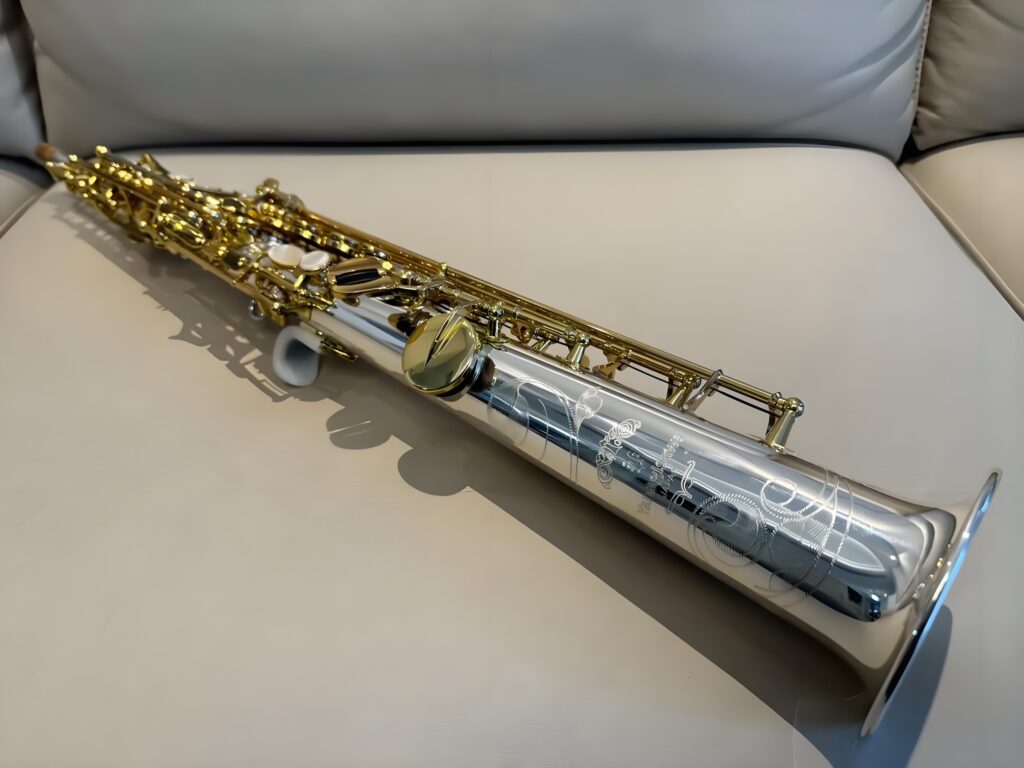
Straight or curved? The key choice
| Straight (like a clarinet) | Curved | |
|---|---|---|
| Sound | more focused, projects forward | warmer, rounder, returns to the player |
| Ergonomics | sound goes down; harder to hear yourself | comfier hold; better self-monitoring |
| Tradition | classical, modern jazz | like a small alto |
In practice the difference in sound is subtler than people think and depends more on the player and mouthpiece than the shape. Straight dominates in classical and modern jazz; curved is often comfier for players coming from the alto. Want both? Look for a model with interchangeable straight/curved necks.
Is the soprano a good first instrument?
Usually no. The soprano is hard to play in tune: its short tube makes pitch very sensitive to embouchure, and keeping it in tune needs a developed setup. That’s why teachers almost unanimously recommend starting on the alto (or tenor) and coming to the soprano later. If you do start on soprano, work with a teacher and a tuner.
👉 Compare prices and availability at specialist retailers.What to look for
- B♭ pitch — the soprano standard; High F# key on most student models.
- Brass body, usually lacquered; fixed or interchangeable neck (straight/curved).
- What’s included — mouthpiece, case, strap; plus warranty/UK service.
Models available in the UK (indicative prices, 2026)
| Model | Shape | Approx. price | Positioning |
|---|---|---|---|
| Gear4music soprano | straight | ~£200–260 | beginner (UK own-brand) |
| Trevor James “The Horn” | straight | ~£900 (check) | student (British brand) |
| Jupiter JSS1000 | straight | ~£1,100–1,300 (check) | advanced |
| Yamaha YSS-475 II | straight (fixed neck) | ~£2,048 | intermediate / semi-pro ⭐ |
Above these sits the professional Yamaha YSS-82Z. The Gear4music soprano remains the cheapest way to try the instrument.
Accessories
- Soprano reeds (smaller than alto), strength 2–2.5 to start.
- A tuner — on the soprano it’s a necessity while learning to play in tune.
- Factory mouthpiece to start; see mouthpiece & reeds.
- Swab and care — see maintenance.
Learning to play the soprano in tune
The soprano’s reputation for difficulty comes down to one thing: intonation. Its short tube makes every note highly sensitive to embouchure and air support, so small changes that pass unnoticed on an alto show up as tuning problems here. A few habits help. Practise long tones with a tuner running so your ear and embouchure calibrate together; keep a steady, well-supported air column rather than pinching for pitch; and don’t fight a poor setup — a stable mouthpiece and an appropriate reed strength make far more difference than willpower. Most teachers advise coming to the soprano with an alto foundation already in place, precisely so you’re solving tuning rather than learning the instrument from scratch.
How much to spend
Budget shapes the choice more than usual on this type. Around £200–260, a Gear4music straight soprano lets you try the instrument cheaply, but the cheapest horns are the hardest to play in tune — a real drawback here. Student models such as the Trevor James “The Horn” sit higher, and the Yamaha YSS-475 II (around £2,048) is the “for years” intermediate whose better intonation and action genuinely justify the step up once you’re committed. If you only want to dabble, start cheap; if you’re serious about the soprano voice, saving for the 475 avoids buying twice.
Where the soprano fits best
The soprano earns its place in specific settings rather than as an all-rounder. Its focused, lyrical voice is prized in classical repertoire, in modern and spiritual jazz (think of the sound John Coltrane made famous on the instrument), and in saxophone ensembles, where it carries the top line. It’s less obviously the tool for a first, general-purpose instrument — which is why almost everyone meets it as a second saxophone. If that’s the music pulling you toward the soprano, the demands are worth it; if you simply want a versatile horn to learn on, the alto will serve you far better while you build the control the soprano requires.
FAQ
Straight or curved for a beginner?
If you go for a soprano, curved is often comfier to hold and hear, especially coming from the alto. Sound-wise the difference is subtle.
Why is the soprano hard?
Its short tube makes tuning very sensitive to embouchure; keeping a clean sound needs a developed setup — hence the advice to start on the alto.
Is an interchangeable-neck soprano worth it?
Yes, if you’re torn between straight and curved: interchangeable necks give you both shapes in one instrument.
For the full family overview, see types of saxophone.
Specs from manufacturers and specialist retailers; prices indicative (2026) and vary by retailer and version.
🎷 Essential accessories for saxophonists
As an Amazon Associate I earn from qualifying purchases.