
Mouthpiece, reed and ligature make up your setup — and that’s where much of your sound comes from, more than the instrument itself. The problem: every brand numbers things differently and online advice contradicts itself. This guide sorts it out with concrete charts — mouthpiece tip openings in mm and reed strengths across brands — plus reed break-in and storage.
Tip opening
The tip opening is the gap between the mouthpiece tip and the reed tip. Europe uses mm (Selmer, Yamaha), the US hundredths of an inch (Meyer, Otto Link). Rule of thumb:
- More open → more volume and flexibility, but needs more air, is more resistant, and pairs with a softer reed.
- More closed → easier response, better control of tone and tuning, focused sound; pairs with a harder reed.
Tip opening chart — ALTO (indicative, mm)
| Mouthpiece | Size | Opening ~mm |
|---|---|---|
| Selmer S90 | 170 / 180 / 190 / 200 | 1.35 / 1.45 / 1.55 / 1.65 |
| Selmer S80 | C / C* / C** | 1.45 / 1.55 / 1.65 |
| Yamaha | 4C / 5C | 1.60 / 1.70 |
| Meyer | 5M / 6M / 7M | 1.80 / 1.93 / 2.06 |
Tip opening chart — TENOR (indicative, mm)
| Mouthpiece | Size | Opening ~mm |
|---|---|---|
| Yamaha | 4C / 5C | 1.70 / 1.80 |
| Selmer S80 | C* / C** / D | 1.90 / 2.00 / 2.10 |
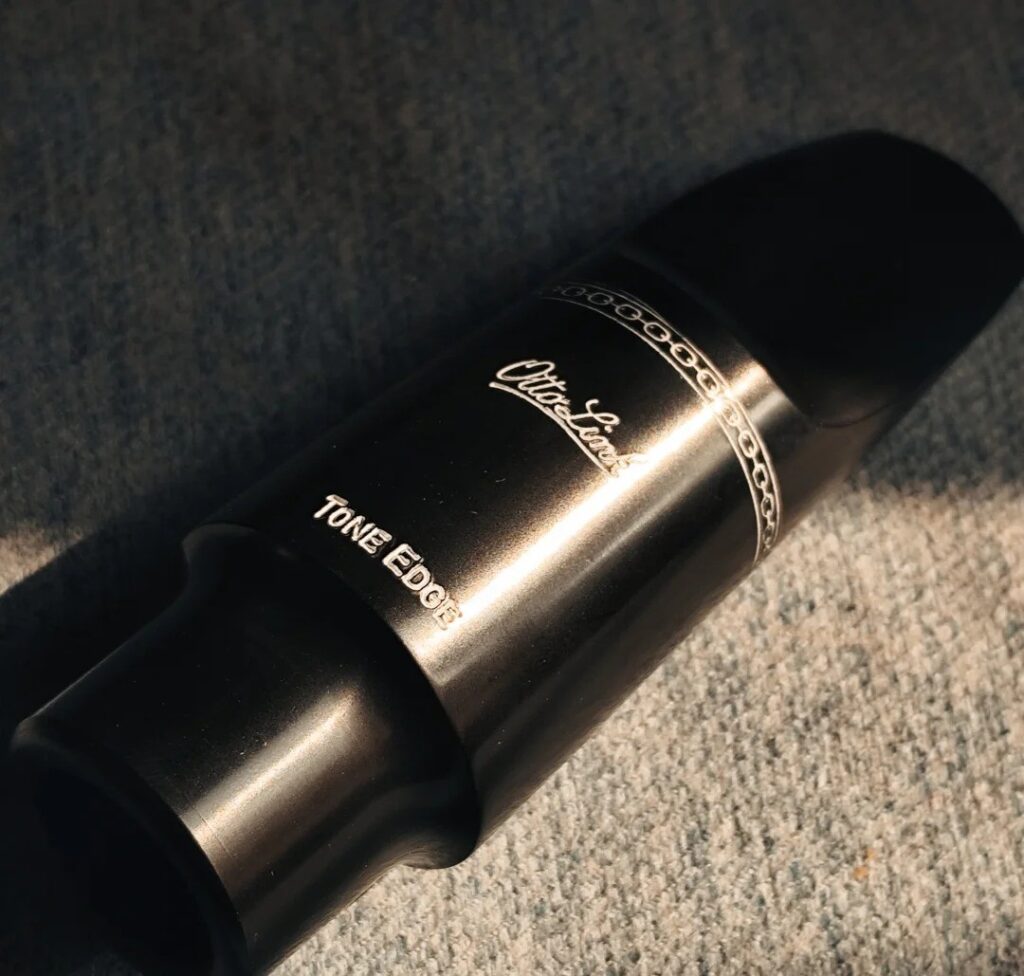
| Otto Link (Tone Edge ebonite / STM metal) | 6 / 6* / 7 / 7* / 8 | 2.29 / 2.41 / 2.54 / 2.67 / 2.79 |
Note: numbering is not comparable across brands — a Meyer “5”, an Otto Link “7” and a Selmer “C*” are different openings. Only the mm value compares. (Selmer openings are current; older models differ. mm values are approximate.)
👉 Compare prices and availability at specialist retailers.Reeds: strengths and (approximate) cross-brand equivalence
| Line | Scale | Step |
|---|---|---|
| Rico | 1.5–4 | 0.5 |
| Rico Royal / Vandoren Traditional | 1–5 | 0.5 |
| Vandoren V12 / V16 / Java | 2/2.5–5 | 0.5 |
| La Voz | Soft → Hard (non-numeric) | — |
| Légère (synthetic) | ~2–4.5 | 0.25 |
Indicative (per manufacturer charts): a Rico/Rico Royal strength X ≈ Vandoren Traditional strength X (near 1:1), and La Voz S ≈ 2, M ≈ 3, H ≈ 4. Honest note: many players find Vandoren about half a strength harder at the same number — use the chart as a starting point.
Golden rule: opening ↔ strength
More open mouthpiece → softer reed; more closed → harder reed.
For beginners
On alto and tenor, start with a 2 or 2.5 reed and a closed mouthpiece like the Yamaha 4C (or Selmer S80 C* for classical): easy response and good tuning control. Go up half a strength at a time.
Mouthpiece by style
- Beginner → closed (Yamaha 4C, Selmer S80 C*).
- Classical → closed openings, pure tone (Selmer S80 / S90).
- Jazz → Meyer (alto), Otto Link (tenor), the historic references.
- Funk/rock/lead → metal high-baffle, large openings.
Material (ebonite/metal/plastic) matters less than the internal geometry (chamber, baffle, opening, facing).
👉 Compare prices and availability at specialist retailers.Reed break-in & storage
- Wet in room-temperature/lukewarm water for 1–2 min (never hot; no more than ~10–15 min).
- Play briefly first — a few minutes (Vandoren’s own advice).
- Ramp up over the next days.
- Rotate 3–4 reeds; store flat at stable humidity (Reed Vitalizer). More in maintenance.
Cane vs synthetic (Légère)
Synthetic reeds need no soaking or break-in, are climate-stable and hygienic and last for months (pricier each). Cane offers the widest tonal palette (classical reference) but is humidity-sensitive and varies reed to reed.
FAQ
What reed for the factory mouthpiece?
With a closed student mouthpiece (Yamaha 4C), a 2–2.5 reed is the ideal start.
Does a harder reed sound better?
Not by itself — it must match the opening. Too hard on a closed mouthpiece “chokes”; too soft on an open one closes the sound.
Are cross-brand equivalences reliable?
Only as a guide: manufacturers themselves call them approximate. Always confirm by trying.
See also alto and tenor guides.
Openings/equivalences from manufacturers (Selmer, Yamaha, JJ Babbitt, Vandoren, D’Addario, Légère); indicative and, for reeds, explicitly approximate. mm rounded.
Field feedback : Synthetic vs cane reeds: players' real experience.
Read also: Electronic Saxophone: Buying Guide (Yamaha YDS, Roland Aerophone, Akai EWI) · Essential accessories for the beginner saxophonist
🎷 Essential accessories for saxophonists
As an Amazon Associate I earn from qualifying purchases.