
An electronic saxophone lets you play through headphones without disturbing anyone, carry hundreds of sounds in a light instrument and connect via MIDI. But “electronic saxophone” actually covers two different families — don’t confuse them before spending several hundred pounds. We explain the difference, the use cases, and compare the real models with UK prices (2026).
Two different families
| Digital saxophone | Wind controller (wind synth) | |
|---|---|---|
| Examples | Yamaha YDS-150 / YDS-120 | Roland Aerophone, Akai EWI |
| Philosophy | recreate the sax experience | versatility: many sounds & fingerings |
| Fingering | saxophone, native | several (sax, flute, oboe, EWI…) |
| Sounds | sax-focused | hundreds (acoustic + synth) |
In short: a saxophonist who wants to keep the feel (and play silently) → digital saxophone (Yamaha YDS-150). A versatile musician wanting hundreds of sounds and several fingerings for stage/studio → wind controller (Roland Aerophone, Akai EWI).
What is it for?
- Silent practice (the #1 reason) — all play through headphones; the YDS-150 only “sounds silent” with headphones.
- Versatility & MIDI — MIDI controller (USB; the EWI5000 adds 5-pin MIDI) for stage and home studio.
- Travel / small spaces — light (0.5–1.1 kg).
For a beginner? The honest truth
- Pro (fingering): the key layout matches an acoustic sax, so the fingering transfers.
- Con (embouchure & air): on the YDS-150 the reed is synthetic and doesn’t vibrate (sound from a breath sensor) → you don’t develop true embouchure. A wind controller is further still from the sax feel.
Bottom line: excellent for practising fingering and playing silently, but it doesn’t replace learning embouchure on an acoustic sax. For a first “real” sax, start on the alto.
👉 Compare prices and availability at specialist retailers.Models available in the UK (indicative prices, 2026)
| Model | Type | Sounds | Sax fingering | Speaker | Approx. price |
|---|---|---|---|---|---|
| Roland AE-01 (mini) | controller | 6 + 50 (app) | ❌ recorder-style | yes | ~£247 |
| Roland AE-05 (GO) | controller | 11 + app | ✅ | yes | ~£372 |
| Akai EWI Solo | controller | 200 | ✅ (sax mode) | yes | ~£400–450 |
| Akai EWI5000 | wireless controller | ~100 | ✅ | ❌ | ~£529 |
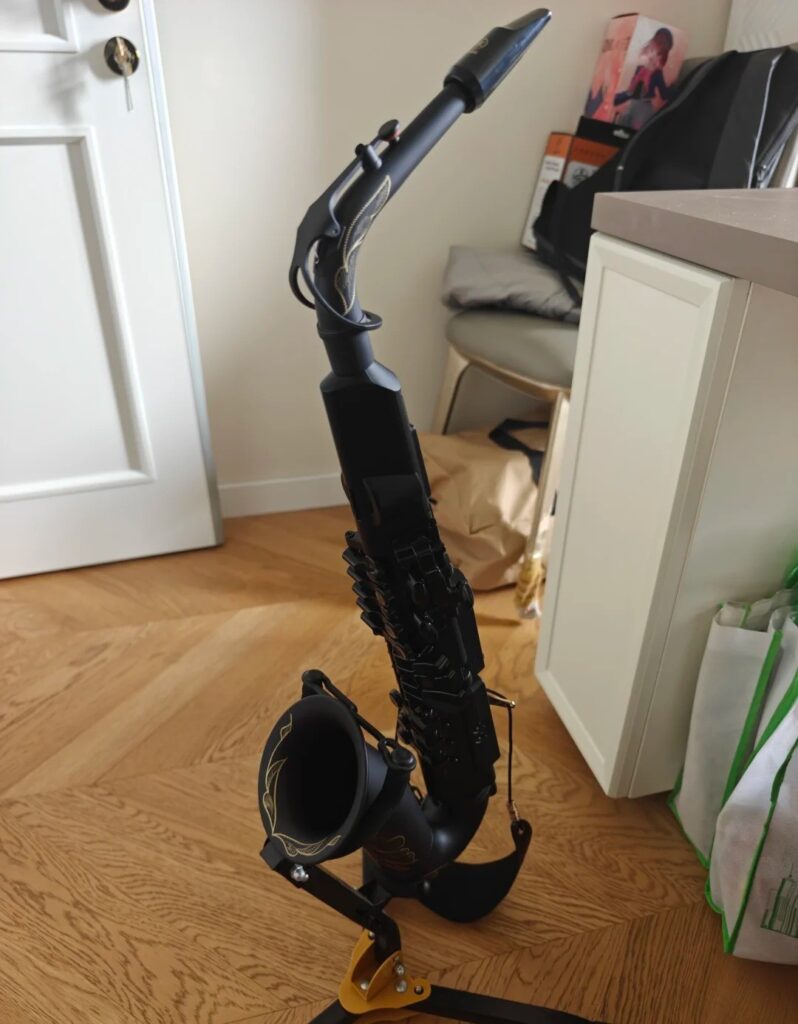
| Yamaha YDS-150 | digital sax | 73 (56 sax) | ✅ native | yes (brass bell) | ~£600–700 |
| Roland AE-20 | wind instrument | 250+ | ✅ (+ others) | yes | ~£739 |
| Roland AE-30 (Pro) | wind instrument | 300+ | ✅ (+ brass…) | yes | ~£1,299 |
The Yamaha YDS-120 sits below the YDS-150. The Akai EWI USB (older) is a pure MIDI controller with no sounds or speaker (needs a computer). Some prices vary by retailer — check current price.
Recommendation by profile
- Saxophonist wanting silent practice → Yamaha YDS-150.
- Budget / to try → Roland AE-05 or Akai EWI Solo.
- Stage/studio, max versatility → Roland AE-20 or AE-30.
- Gift / cheap start → Roland AE-01 (mini), noting its fingering isn’t the sax’s.
Practical considerations before buying
Beyond the digital-versus-controller choice, a few practical points decide whether an electronic saxophone will actually suit you. Headphones and silent practice are the main draw, so check the instrument does what you need: models like the Yamaha YDS-150 only truly go silent through headphones, while several controllers include a small built-in speaker for practice without them. Connectivity matters if you’ll use it with software — most connect over USB MIDI, and a few (such as the EWI5000) add traditional 5-pin MIDI for stage rigs. Think about power and portability too: battery options and low weight (0.5–1.1 kg) make these easy to travel with, which is part of the appeal. Finally, be clear-eyed about the fingering: the sax-fingering models transfer your technique directly, but the cheapest recorder-style controllers do not, so a bargain price can mean relearning the layout.
Who should skip it
An electronic saxophone is a superb complement — for silent practice, travel and MIDI — but it isn’t a substitute for learning embouchure and air on an acoustic horn. If your goal is to become a saxophonist, start on an acoustic alto and treat the electronic instrument as a quiet-practice tool alongside it, not instead of it.
How good do they actually sound?
Modern electronic saxophones and wind controllers have come a long way. Through headphones or a decent speaker, the better models produce genuinely convincing acoustic-sax sounds alongside synth and other instrument voices, and companion apps let you tweak and expand the sound library well beyond the presets. What they can’t reproduce is the feel of a vibrating reed — the sound comes from breath and bite sensors — so the experience gets close without being identical. For silent practice, travel and studio work that’s a fair trade; as a substitute for developing real embouchure, it isn’t one, which is why these instruments work best alongside an acoustic horn rather than in place of it.
FAQ
Does an electronic saxophone sound like an acoustic one?
It produces convincing sounds via headphones/speaker, but the mechanism differs (sensors, not a vibrating reed). The feel gets close, not identical.
Can you learn the saxophone on an electronic one?
You learn the fingering (which transfers). Not embouchure or air control — for that you need an acoustic sax.
Yamaha YDS or Roland Aerophone?
YDS for the most “sax” experience; Aerophone for hundreds of sounds and more versatility.
For the full overview, see types of saxophone.
Specs from manufacturers (Yamaha, Roland, Akai); prices indicative (2026), some to confirm.
🎷 Essential accessories for saxophonists
As an Amazon Associate I earn from qualifying purchases.